



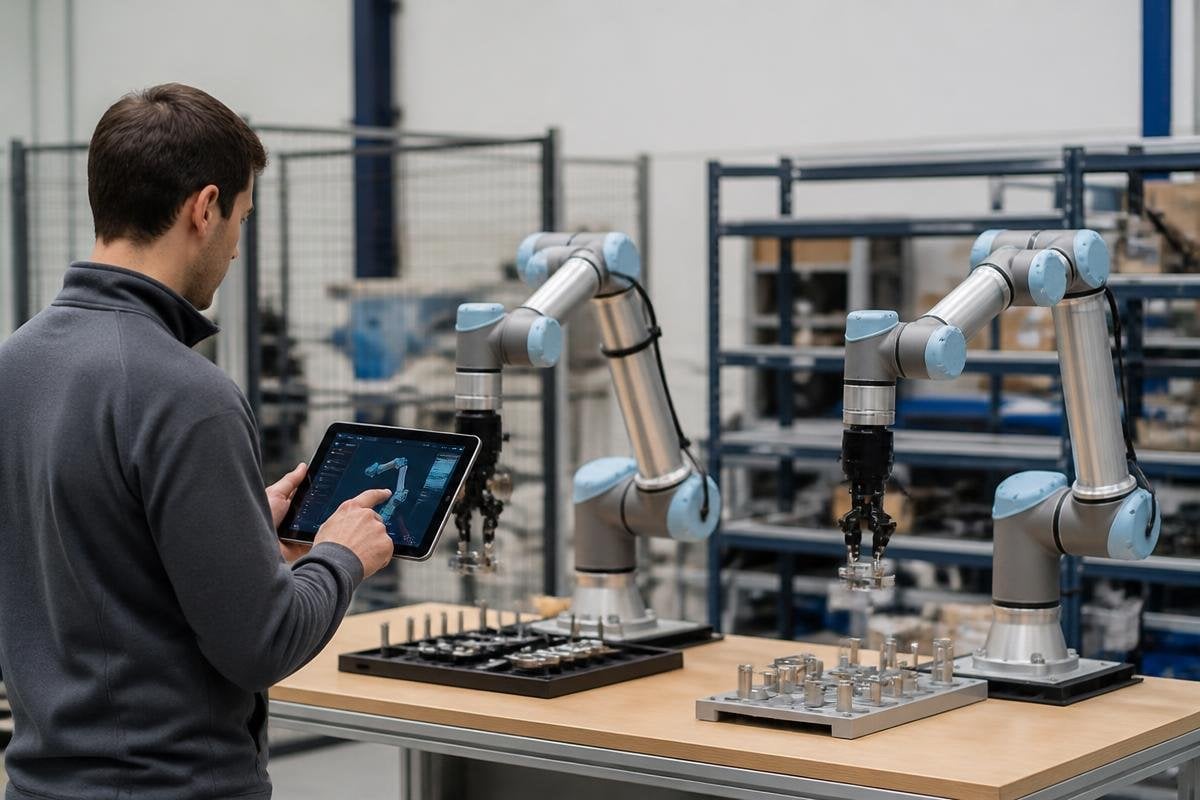
A robot can teach another robot by passing on data, movement plans, or a trained control policy. The method saves repeated setup work, but it only works well when the second robot has similar hardware and faces the same task.
Quick read
- One robot can copy motion data from another
- A shared policy still needs checks on the new robot
- Different grippers, cameras, and floor layouts can break the transfer
What robot teaching means
Robot teaching usually means transferring useful information from one machine to another. That information might be a path for a robot arm, a set of camera observations, or a policy that links sensor input to motor commands.
A policy is the rule a robot follows while it works. For a mobile robot, the policy may turn LiDAR readings into steering commands. For a robot arm, it may use camera data to move a gripper toward a part.
The first robot does not need to explain the task in human language. It can record what it saw and how its joints moved. A second robot can then use those records as training data, or it can copy the policy and adjust the motion for its own body.
That difference matters. Copying a path is useful when the robots have matching joints and tools. Copying a policy may work across different hardware, but the second robot needs enough data to learn how its body responds.
Three ways machines pass on skills
The simplest method is demonstration. A person or robot moves an arm through a task, and the second robot repeats the recorded sequence. This works well for fixed actions such as picking a part from a known tray.
Imitation learning adds more detail. The robot studies many examples of what to do after different camera views or object positions. It then chooses an action when a new scene looks close to something in its training data.
A third method uses simulation. Engineers build a virtual version of the robot, train a policy there, and move the policy to physical hardware. The simulation can produce many trials without wearing out motors.
Small errors in weight, grip, or timing can cause trouble on the real machine. That makes checks on the physical robot part of the transfer.
Teleoperation adds another route, where a person controls one robot from a distance. The control data gives the next robot a record of hand position, force, and timing. That record becomes more useful when the task needs contact with an object, such as inserting a plug or closing a lid.
Hand position and force can teach a motion, but they don’t prove that another robot can repeat it on a different table. Robot 24 can point you to coverage that names the machine, task, and test behind such claims. That evidence leads to the next problem: where the transfer breaks.
Where the transfer breaks
A copied skill depends on the body that learned it. A two-finger gripper cannot pass the same motion directly to a suction tool, and a robot with a shorter arm may reach the target from a different angle.
Sensors create another gap. A camera mounted 5 cm higher changes the view of a part. A mobile robot that uses LiDAR may also see different readings after the floor, shelves, or lighting change.
Timing matters too. A policy trained with one motor speed may send poor commands to a slower joint. Contact tasks are harder because the robot must respond to force, not only position. The second machine needs checks before it works near people or costly parts.
The unproven part is broad transfer. A robot may copy a task across a small group of similar machines, yet fail when the tool, object, or work area changes. A successful lab handoff does not prove that a fleet can learn every job from one example.
A buying and deployment checklist
Use these checks before you fund a robot-teaching project:
- Match the bodies first. Compare joint limits, payload, reach, gripper type, and sensor position.
- Record the task. Keep camera data, joint motion, contact force, and timing together.
- Test easy cases. Start with fixed object locations before adding loose parts or moving people.
- Measure failure. Track missed picks, dropped parts, emergency stops, and recovery time.
- Keep a manual mode. Give technicians a safe way to pause, inspect, and correct the robot.
- Set a transfer limit. Define the tool, object range, and floor layout the policy may handle.
The useful line to draw
Robot teaching makes sense when many machines repeat a narrow task and share enough hardware. It becomes a research problem when the robots have different bodies or must handle objects they have never seen.
I’d fund the data and safety checks before paying for a promise of general robot learning. The next useful test is simple: move one trained policy to a second machine, change one physical detail, and measure how many tasks still work.
